Showing posts with label 3D printing. Show all posts

Wednesday, May 8, 2019

Designing a 3D Fluorimeter for the Field

This semester I was approached by two chemistry students with a 3D modeling idea. Their goal was to design and print a working fluorimeter that could be used in the field with a smart-phone camera. They had already worked out specific design details on paper, but had no experience with 3D design or printing.  

Fluorimeter Design Sketch
Backing up for a moment, let's see what a fluorimeter is actually for:

(via Wikipedia) A fluorometer or fluorimeter is a device used to measure parameters of fluorescence: its intensity and wavelength distribution of emission spectrum after excitation by a certain spectrum of light. These parameters are used to identify the presence and the amount of specific molecules in a medium. Modern fluorometers are capable of detecting fluorescent molecule concentrations as low as 1 part per trillion.

An everyday example of fluorimeter use is in the dairy industry where fluorimetry is used to verify successful pasteurization of milk. If the milk glows, it's not pasteurized!  

I introduced the students to Tinkercad, a beginner-level, but capable online 3D modeling program.  After a few iterations and modifications we were able to design the fluorimeter housing to hold a laser and a special lens adapter.  

3D Model -- Fluorimeter Housing

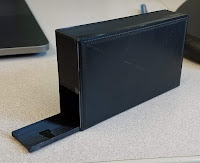
The 3D printed version

The students presented and demonstrated the fluorimeter/smart phone combo for their final chemistry lab this week. Look for future updates with photos of the device at work.


Tuesday, September 12, 2017

Resource Lab Refresh

This summer we've refreshed Resource Lab equipment and software.  The updates include new 27" iMacs with retina screens that can handle 4k video editing, virtual reality development, and 3D modeling.   Software upgrades include the addition of the full Adobe Creative Suite on each machine. That means all of the computers have the most recent versions of Photoshop, Premiere, Illustrator, Lightroom--there are really too many to list, so check it out here.

Another excellent upgrade is the addition of a Lulzbot Taz 6 3D printer.  This printer will allow us to print a wider range of materials like magnetic plastic, circuit printing media, and industrial strength plastics.
Ain't she a beauty


LC community members are encouraged to try out the printer. Where to start? There are loads of free models available from sites like Thingiverse that you may download and print.  If you're worried about costs, don't be!  3D printing is deducted from your LC print balance.  The process to get your print is easier than you might think. Either visit the Resource Lab with a file in hand, or send a file with a print request to itservice@lclark.edu.  We'll help you prep and print the file, or let you know if it's just not something our printer can handle.

So that's what's new in the Rlab.  Don't forget we still have fabulous color printers available to create your academic posters and photo projects.  Give us a call at 503-768-7225 for more information.

Thursday, September 8, 2016

3D Prints - September 2016

Each month, we will be posting 3D prints that our Educational Technologist Justin Counts has helped to create for departments around Lewis & Clark.

This month, we bring you a set of optical illusions printed by the Psychology Department. Enjoy!

                Ambiguous Cylinder Illusion                     M.C. Escher Fish Print 

Slope Illusion

Friday, September 18, 2015

Yes, you can 3D print with glass now...

Credit: Imagery courtesy of the MIT Media Lab
Researchers at at the MIT Glass Lab (yes, they have a glass lab) have figured out how t0 print molten glass through a nozzle.

As you can imagine, the main challenge here are the extremely high temperatures involved.

Finding a nozzle suitable for printing glass is  complicated, to work it must be made of a material that can both handle high temperatures and resist the glass sticking to it.

Platinum nozzles are used in industry for some glass manufacturing processes, but are very expensive. Instead the lab settled on a custom-made nozzle made of aluminum oxide.
The machine prints soda lime glass, a family of glasses used in everything from water glasses to windows. But glasses like Pyrex could in principle be printed this way too, albeit at much higher temperatures.

The technology is still in its nascent stage, but if you could, what would you print out of glass?

Wednesday, September 9, 2015

New 3D printer at LC

This summer Information Technology bought a Makerbot Replicator 5th generation 3D printer to be housed in the Resource Lab in Watzek Library


      The new printer is more reliable, faster, and more affordable than the previous clunker, which has been donated to science.
To celebrate the awesomeness that is the Makerbot,  IT is rolling out a new 3D printing policy.  Any member of the Lewis & Clark community is eligible to use the 3D printer and pay for the print using pages from their print balance.


For example, if you print this model of the Mars Curiosity rover,  it costs about 70 pages of your print balance and takes about 4 hours to print.
We printed one in purple!

You can find plenty of free 3D files online (thingiverse.com) or even design your own model with free software like Google Sketchup.  Look for files with the .stl file extension.

If you've got a hankering to try out 3D printing, contact itservice@lclark.edu (x7225) to set up a printing appointment.